

What Is a ctDNA Test?
Signatera™ is a highly sensitive, tumor-informed Minimal Residual Disease (MRD) test. By analyzing circulating tumor DNA (ctDNA) in the blood, it helps identify the risk of recurrence at an early stage, monitor treatment response, and support clinical decision-making. The Signatera™ test is performed at Natera laboratories in the United States. It is an FDA-approved MRD test and is recommended by international guidelines for several tumor types, including colorectal cancer, breast cancer, and non-small cell lung cancer.
A positive Signatera™ result indicates that traces of tumor-derived DNA have been detected in the blood. In other words, it indicates an increased risk of disease recurrence, as demonstrated in studies such as IMvigor and GALAXY. A negative Signatera™ result means that no traces of tumor-derived DNA were detected in the blood at the time of testing. However, a negative result does not mean that the disease will not recur in the future. Therefore, depending on the physician’s assessment, repeat Signatera™ testing at regular intervals, typically every 3–6 months, may be recommended.
In MRD testing, the tumor-informed approach uses the genetic alterations specific to a patient’s own tumor to provide personalized results. Other MRD tests, known as tumor-naive tests and performed using blood samples without first establishing a personalized tumor profile, may offer more limited sensitivity compared with the tumor-informed approach.
What Questions Can Signatera™ Help Address?
Assessment of treatment response during the neoadjuvant period
Evaluation of the need for adjuvant therapy
Early detection of molecular recurrence
Monitoring treatment response and disease management
Supporting clinical decision-making
When Is Signatera™ Used?
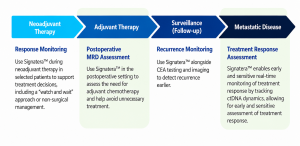
| Clinical Stage | Use of Signatera™ |
|---|---|
| Neoadjuvant Treatment – Response Monitoring | In selected patients, it may be used during neoadjuvant treatment to support the evaluation of a “watch-and-wait” strategy or a non-surgical approach. |
| Adjuvant Treatment – Postoperative MRD Assessment | It supports the assessment of MRD status after surgery and the evaluation of the need for adjuvant therapy, alongside clinical data. |
| Surveillance – Recurrence Monitoring | Used alongside CEA and other imaging methods, it helps detect molecular recurrence earlier and supports disease surveillance. |
| Metastatic Disease – Treatment Response Assessment | Serial ctDNA measurements help monitor changes in treatment response at an early stage. |
How Is Signatera™ Used Across Different Cancer Types?
• Colorectal Cancer
Following surgery and adjuvant treatment, serial ctDNA analysis with Signatera™ can be used to monitor minimal residual disease (MRD) and recurrence risk. This approach may help support adjuvant treatment decisions, follow-up planning, and the early detection of molecular recurrence.
• Breast Cancer
Serial ctDNA measurements during neoadjuvant treatment and after treatment can be used to monitor treatment response and molecular disease status. This may support the assessment of treatment response and recurrence risk.
• Non-Small Cell Lung Cancer (NSCLC)
Serial ctDNA monitoring with Signatera™ can be performed following surgery and systemic treatment. This may help with disease surveillance and the detection of molecular recurrence before clinical or radiological findings become apparent.
• Muscle-Invasive Bladder Cancer (MIBC)
MRD assessment with Signatera™ can be performed following radical cystectomy. This assessment may support the evaluation of recurrence risk and adjuvant treatment options. Signatera CDx has received FDA approval as a companion diagnostic for this use.
• Ovarian, Fallopian Tube, and Primary Peritoneal Cancers
Serial ctDNA measurements following treatment can be used to monitor molecular disease status and potential recurrence. This approach may support the early monitoring of recurrence and ongoing disease surveillance.
• Solid Tumors Treated with Immunotherapy
Serial ctDNA measurements during treatment can be used to monitor changes in tumor-derived DNA. This may support the assessment of molecular response to treatment and disease dynamics.
In addition to these cancer types, Signatera™ is used in gastrointestinal, genitourinary, head and neck cancers, lymphoma, sarcoma, and melanoma.
Why Signatera™?
How Is Signatera™ Performed?
Setup: In the initial stage, the patient’s tumor tissue is analyzed to identify tumor-specific genetic alterations and establish a personalized tumor profile.
Follow-up: During follow-up, blood samples are collected at regular intervals to detect circulating tumor DNA. Serial measurements help monitor the patient’s response to treatment and the potential risk of molecular recurrence.
Our Test Options
| Feature | Signatera Exome™ | Signatera Genome™ | Latitude™ |
|---|---|---|---|
| Cancer Types | All solid tumors, including colorectal, breast, lung, and bladder cancers | All solid tumors, including colorectal, breast, lung, and bladder cancers | Colorectal cancer (CRC) only |
| Method | WES-based Signatera™ mPCR-NGS | WGS-based Signatera™ mPCR-NGS | Tissue-free, DNA methylation-based MRD analysis |
| Number of Variants | 16 clonal variants | 64 clonal variants | Epigenomic biomarker-based analysis |
| Sequencing Depth | Approximately 100,000× ultra-deep sequencing | Up to 350,000× ultra-deep sequencing | Targeted methylation-based analysis |
| Setup Requirements | FFPE tumor tissue + 1 EDTA blood tube + 2 Streck blood collection tubes | FFPE tumor tissue + 2 EDTA blood tubes + 2 Streck blood collection tubes | No tumor tissue required. Setup requires 1 EDTA blood tube and 2 Streck blood collection tubes. |
| Follow-up Requirements | 2 Streck blood collection tubes | 2 Streck blood collection tubes | 2 Streck blood collection tubes |
| Setup Turnaround Time | 4–5 weeks | 4 weeks | — |
| Follow-up Turnaround Time | 7–10 days | 7–10 days | Less than 14 days |
| Key Advantage | Personalized, tumor-informed MRD analysis | Personalized MRD analysis with ultra-high sensitivity, supporting detection even at low ctDNA levels | Fast and practical MRD assessment without requiring tumor tissue |
*For patients with colorectal cancer (CRC), Latitude can be performed using a plasma sample only, without the need for tumor tissue.
Signatera™, tümöre özgü (tumor-informed) yüksek hassasiyetli bir MRD (Minimal Rezidüel Hastalık) testidir. Kanda dolaşan tümör DNA’sını (ctDNA) analiz ederek nüks riskinin erken dönemde belirlenmesine, tedavi yanıtının izlenmesine ve klinik karar süreçlerinin desteklenmesine yardımcı olur. Signatera™, FDA onaylı bir MRD testi olup kolorektal kanser, meme kanseri ve küçük hücreli dışı akciğer kanseri dahil birçok tümör türü için uluslararası kılavuzlarca önerilmektedir.
Neden Signatera™?
Signatera™ Ne Zaman Kullanılır?

–
| Özellik | Signatera Ekzom™ |
| Kanser Türü | Tüm Solid Tümörler (Kolorektal, Meme, Akciğer, Mesane vb.) |
| Yöntem | Wes Tabanlı Signatera™ mPCR-NGS |
| Varyant Sayısı | 16 Klonal Varyant |
| Dizileme Derinliği | ~100.000x ultra derin analiz |
| Kurulum (Setup) | FFPE Tümör Dokusu + 1x EDTA’lı Kan Tüpü + 2x Streck Kan Tüpü |
| Takip (Follow-up) | 2x Streck Kan Tüpü |
| Sonuç Süresi (Setup) | 4 – 5 Hafta |
| Sonuç Süresi (Follow-up) | 7 – 10 Gün |
| Öne Çıkan Avantaj | Kişiselleştirilmiş, tümöre özgü MRD analizi |
| Özellik | Signatera Genom™ |
| Kanser Türü | Tüm Solid Tümörler (Kolorektal, Meme, Akciğer, Mesane vb.) |
| Yöntem | WGS Tabanlı Signatera™ mPCR-NGS |
| Varyant Sayısı | 64 Klonal Varyant |
| Dizileme Derinliği | 350.000x’e kadar ultra derin analiz |
| Kurulum (Setup) | FFPE Tümör Dokusu + 2x EDTA’lı Kan Tüpü + 2x Streck Kan Tüpü |
| Takip (Follow-up) | 2x Streck Kan Tüpü |
| Sonuç Süresi (Setup) | 4 Hafta |
| Sonuç Süresi (Follow-up) | 7 – 10 Gün |
| Öne Çıkan Avantaj | Ultra yüksek hassasiyetli, kişiselleştirilmiş MRD analizi ile düşük ctDNA düzeylerinde dahi güçlü saptama performansı |
| Özellik | Latitude™ |
| Kanser Türü | Yalnızca Kolorektal Kanser (CRC) |
| Yöntem | Doku gerektirmeyen DNA metilasyon tabanlı MRD analizi |
| Varyant Sayısı | Epigenomik biyobelirteç temelli analiz |
| Dizileme Derinliği | Metilasyon bazlı hedefli analiz |
| Kurulum (Setup) | Tümör dokusu gerektirmez. Kurulum için 1x EDTA’lı Kan Tüpü ve 2x Streck Kan Tüpü örneği yeterlidir. |
| Takip (Follow-up) | 2x Streck Kan Tüpü |
| Sonuç Süresi (Setup) | – |
| Sonuç Süresi (Follow-up) | <14 gün |
| Öne Çıkan Avantaj | Tümör dokusu gerektirmeden hızlı ve pratik MRD değerlendirmesi |